


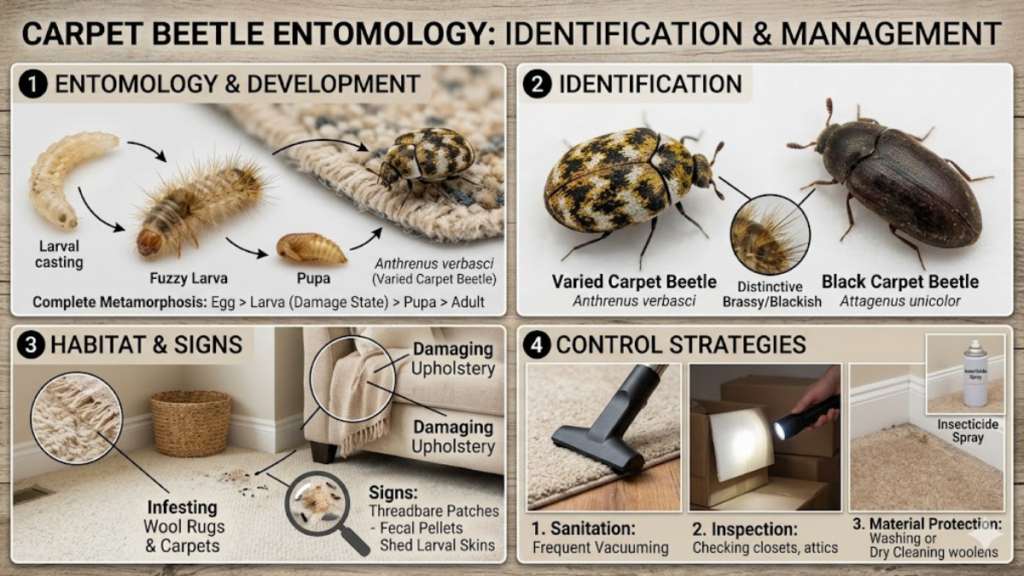
Carpet beetles are a globally distributed group of insects belonging to the family Dermestidae, widely recognized for their ability to damage natural fibers and animal-based materials in human environments. From an entomological standpoint, these insects are not just household pests but ecologically important decomposers that contribute to the breakdown of animal remains, feathers, and organic debris in natural ecosystems. Their biological adaptability allows them to thrive in diverse habitats, ranging from bird nests and animal burrows to residential homes, museums, and storage facilities.
Understanding carpet beetle entomology, identification, control methods, and developmental biology is essential for both scientific and practical reasons. In homes, infestations often go unnoticed until significant damage has occurred to carpets, clothing, upholstery, and stored fabrics. In institutional settings such as museums and textile archives, carpet beetles pose a serious threat to preserved biological specimens and historical materials.
Their lifecycle and feeding behavior make them particularly challenging to manage. While adult beetles typically feed on pollen outdoors, it is the larval stage that causes destruction indoors by consuming keratin-rich materials such as wool, silk, fur, and feathers. This dual ecological role complicates control strategies and requires a deep understanding of their biology.
This article provides a comprehensive, research-based exploration of carpet beetles, including how they are biologically “made” through complete metamorphosis, how to identify them accurately, and the most effective control strategies used in modern integrated pest management systems.
Table 1: Carpet Beetle Overview
| Category | Details |
|---|---|
| Scientific Family | Dermestidae |
| Common Species | Anthrenus verbasci, Attagenus unicolor, Anthrenus flavipes |
| Development Type | Complete metamorphosis |
| Life Stages | Egg → Larva → Pupa → Adult |
| Damage Stage | Larva only |
| Diet | Wool, silk, feathers, leather, dead insects, pet hair |
| Habitat | Homes, museums, bird nests, warehouses |
| Seasonal Activity | Spring and summer peak adult activity |
| Control Priority | Sanitation and larval elimination |
Entomology of Carpet Beetles
Carpet beetles belong to the Dermestidae family, a group of Coleoptera characterized by scavenging behavior and specialized digestive systems capable of breaking down animal-derived proteins. From an entomological perspective, dermestids are evolutionarily adapted to occupy ecological niches involving decomposition, making them essential contributors to nutrient cycling in natural ecosystems.
Their morphology reflects this ecological specialization. Adult carpet beetles are small, oval-shaped insects with patterned elytra that often mimic environmental textures, providing camouflage among flowers and outdoor surfaces. Larvae, in contrast, are elongated, bristly organisms with dense setae (hair-like structures) that provide both protection and sensory input. These hairs also play a defensive role, deterring predators and aiding in environmental navigation.
The digestive physiology of carpet beetle larvae is particularly significant. They produce enzymes capable of breaking down keratin, a structural protein found in hair, feathers, and wool. This biochemical capability is relatively rare in insects and is the reason carpet beetles can thrive on materials that are otherwise resistant to decomposition.
Ecologically, carpet beetles are opportunistic scavengers. In natural environments, they consume dead insects, animal carcasses, and shed feathers. In human environments, they shift their feeding behavior to synthetic substitutes of these materials, including carpets, clothing, and upholstery made from natural fibers. This adaptability is a key factor in their global distribution and persistence as household pests.
Their evolutionary success is also linked to reproductive efficiency. Female carpet beetles lay eggs in concealed environments where food availability is high, ensuring larval survival. This reproductive strategy increases infestation potential in environments rich in organic debris.
Identification of Carpet Beetles
Accurate identification of carpet beetles requires distinguishing between adult and larval stages, as their appearance and behavior differ significantly.
Adult carpet beetles are typically 1.5 to 4 millimeters in length and exhibit rounded or oval bodies. Their coloration varies by species, often featuring mottled patterns of white, yellow, brown, and black scales. These patterns are not merely decorative but serve as camouflage in natural environments such as flowers and vegetation.
Larvae are the most commonly encountered stage indoors. They are elongated, carrot-shaped, and covered in dense bristles. These larvae avoid light and are typically found in dark, undisturbed areas such as under furniture, inside closets, along baseboards, and within stored fabrics. Their movement is slow but persistent as they search for food sources.
One of the most reliable identification indicators is the presence of shed larval skins. As larvae grow, they molt multiple times, leaving behind translucent exoskeletons. These remnants often accumulate in hidden areas and serve as early warning signs of infestation.
Feeding damage is another key identifier. Carpet beetles create irregular holes in natural fibers, often concentrated in hidden or protected areas of fabrics. Unlike other pests that feed in uniform patterns, carpet beetle damage appears scattered and inconsistent.
Misidentification is common, especially with clothes moths. However, moth larvae produce silk webbing, while carpet beetle larvae do not. Recognizing these differences is essential for selecting appropriate control measures.
How Carpet Beetles Are Made (Life Cycle and Development)
Carpet beetles undergo complete metamorphosis, a developmental process involving four distinct stages: egg, larva, pupa, and adult. Each stage plays a different ecological role and contributes uniquely to population survival.
Eggs are deposited in concealed locations rich in organic material. These eggs are microscopic and often laid in clusters. Depending on environmental conditions such as temperature and humidity, eggs hatch within a few days to several weeks.
Larvae emerge as the primary feeding stage. This is the most destructive phase of the carpet beetle lifecycle. Larvae feed continuously on keratin-rich materials, growing through multiple instars. The larval stage can last from several months to over a year depending on environmental conditions and food availability.
D=F⋅HTD = \frac{F \cdot H}{T}D=TF⋅H
This conceptual relationship illustrates how developmental duration (D) is influenced by food availability (F), humidity (H), and temperature (T), showing that warmer and food-rich environments accelerate growth.
Once fully developed, larvae enter the pupal stage. During pupation, they undergo complete internal and external restructuring. This transformation occurs in hidden areas such as fabric folds, carpet edges, or crevices.
Adults emerge from pupae with fully developed wings and reproductive organs. Their primary role is reproduction and dispersal. Adults typically live only a few weeks and feed mainly on nectar and pollen outdoors, making them ecologically distinct from larvae.
Understanding this lifecycle is essential for control strategies because eliminating adults alone does not stop infestations; larvae must be targeted to break the cycle.
Carpet Beetle Damage and Infestation Behavior
Carpet beetle infestations develop gradually and often remain unnoticed until significant material damage occurs. The larvae are responsible for all structural damage, as they feed on natural fibers containing keratin and other animal proteins.
Textile damage is the most common outcome. Wool carpets, silk garments, and upholstered furniture are particularly vulnerable. Damage typically appears as irregular holes, often concentrated in undisturbed or hidden areas where larvae feed without interruption.
In institutional environments such as museums, carpet beetles pose a serious conservation threat. They can destroy taxidermy specimens, insect collections, and historical textiles. Their ability to digest preserved biological materials makes them particularly destructive in archival settings.
Carpet beetles may also cause indirect health concerns. Larval hairs can cause dermatological reactions in sensitive individuals, leading to itching, rashes, or mild respiratory irritation. While they do not bite or transmit diseases, their physical presence can still impact human comfort.
Infestation severity is influenced by environmental conditions. Dust accumulation, pet hair, and lack of cleaning significantly increase the likelihood of infestation by providing continuous food sources for larvae.
Control and Management Strategies
Effective carpet beetle control requires a multi-layered approach combining sanitation, mechanical removal, environmental modification, and chemical intervention when necessary.
Sanitation is the foundational step. Regular vacuuming of carpets, upholstery, and hidden corners removes larvae, eggs, and food debris. Special attention must be given to edges and storage areas where infestations typically begin.
Heat treatment is highly effective. Washing fabrics at high temperatures and using heat drying cycles eliminates all life stages of carpet beetles. This is particularly important for clothing storage areas.
Environmental control is equally important. Reducing dust accumulation and removing organic debris such as pet hair significantly reduces larval food sources. Sealing cracks and entry points also prevents adult beetles from entering indoor spaces.
Chemical control may be used in severe infestations. Residual insecticides target larvae in hidden areas, although they are most effective when combined with sanitation practices.
Natural control methods include desiccant powders such as diatomaceous earth, which damage the insect’s protective outer layer, leading to dehydration and death.
Integrated Pest Management (IPM) Approach
Integrated Pest Management provides the most effective long-term strategy for carpet beetle control. IPM combines inspection, monitoring, prevention, and targeted intervention.
Inspection identifies infestation sources and hotspots. Monitoring tools such as sticky traps help track adult beetle activity, indicating potential larval development indoors.
Preventive measures focus on eliminating conditions that support infestation. This includes reducing humidity, improving ventilation, and maintaining strict cleaning routines.
Targeted interventions involve the use of insect growth regulators and localized insecticides. These disrupt the developmental cycle and prevent larvae from reaching maturity.
IPM emphasizes sustainability by minimizing chemical use while maximizing long-term effectiveness through environmental control.
Conclusion
Carpet beetles are biologically complex insects with a dual ecological identity: beneficial decomposers in nature and destructive pests in human environments. Their entomological characteristics, including keratin digestion and complete metamorphosis, make them highly adaptable and difficult to control without a structured approach.
Understanding their lifecycle is critical, particularly the larval stage responsible for all material damage. Identification based on morphology and feeding patterns enables early detection, which is essential for preventing large-scale infestations.
Effective control requires a combination of sanitation, environmental management, and targeted treatments under an integrated pest management framework. As urban environments continue to expand, carpet beetles are likely to remain persistent household and institutional pests.
Long-term prevention depends on consistent cleaning, monitoring, and environmental control, ensuring that conditions unfavorable to larvae development are maintained.
Check Out More Interesting Stories!
FAQs
What is the main cause of carpet beetle infestations?
Carpet beetle infestations are primarily caused by the availability of natural fibers and organic debris such as wool, pet hair, and dust. Poor cleaning practices and stored fabrics provide ideal conditions for larval development.
How can carpet beetles be identified in a home?
They are identified through irregular fabric damage, presence of bristly larvae, and shed skins in hidden areas. Adults may also be seen near windows or light sources.
Do carpet beetles bite humans?
No, carpet beetles do not bite or sting humans. However, larval hairs may cause allergic reactions or skin irritation in sensitive individuals.
What is the most effective carpet beetle treatment?
The most effective treatment combines deep cleaning, heat washing of fabrics, vacuuming, and targeted insecticide application. Eliminating larvae is essential for full control.
Can carpet beetles return after treatment?
Yes, reinfestation can occur if food sources and favorable conditions remain. Continuous cleaning and monitoring are necessary to prevent recurrence.