


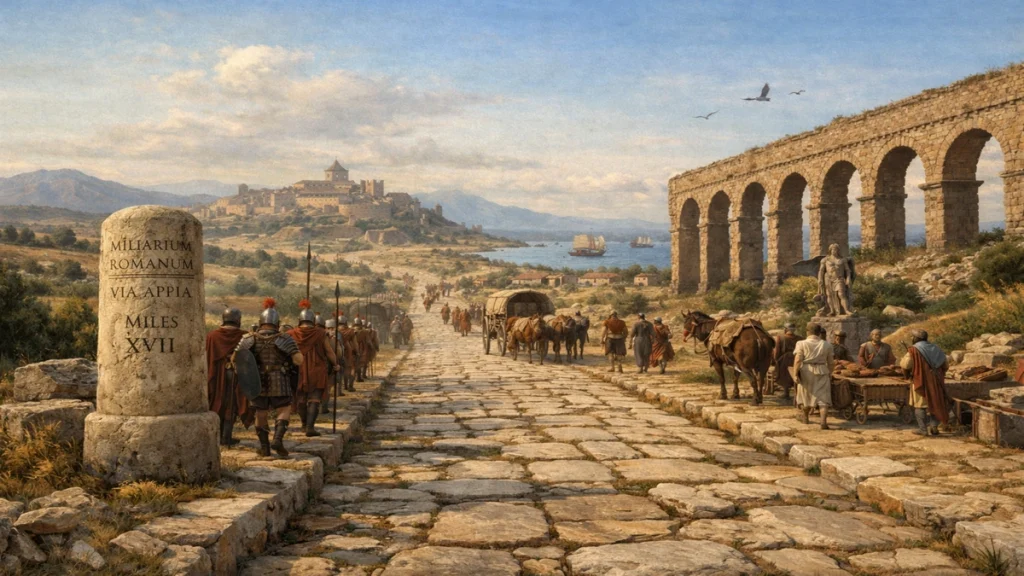
Cesta Roman refers to the vast system of roads constructed by the Roman Empire to connect its cities, provinces, military outposts, and trade centers. These roads were not only transportation routes but instruments of governance, economic integration, and cultural unification. By the height of the empire, Rome had built hundreds of thousands of kilometers of roads, many of which still influence the layout of modern Europe today.
The Roman road system made it possible for legions to move quickly, for officials to administer distant provinces, and for merchants to circulate goods across continents. Grain from Egypt, wine from Gaul, olive oil from Hispania, and marble from Greece all moved along these routes. Messages could travel across the empire in days rather than months, allowing Rome to govern efficiently over enormous distances.
The durability of Roman roads remains one of their most impressive features. Built with layered stone foundations, precise surveying, and drainage systems, they were designed to last. Even after the fall of the Western Roman Empire, these roads continued to serve medieval travelers, pilgrims, and traders.
Cesta Roman therefore represents one of history’s most influential infrastructural achievements. It shaped not only how people traveled, but how civilizations formed, interacted, and endured across time.
The Origins of the Roman Road System
Roman road building began during the Republic as Rome expanded beyond its original territory. Early roads such as the Via Appia, constructed in 312 BCE, connected Rome to southern Italy and set the standard for later construction.
As Rome conquered new lands, roads followed the legions. Every new province was linked back to the capital through physical pathways that allowed control, taxation, and communication. Roads became tools of empire as much as of travel.
Roman surveyors used instruments to measure straight lines and gradients, ensuring roads were as direct as possible. This efficiency reflected Roman values of order, discipline, and authority.
Engineering the Cesta Roman
Roman roads were built in multiple layers to ensure strength and longevity. Large stones formed a stable base. Above this were layers of crushed stone, sand, and gravel, topped with paving stones fitted tightly together.
Roads were crowned in the center to allow water runoff into side ditches, preventing erosion. Milestones marked distances, and waystations provided food, lodging, and fresh horses.
Table: Roman Road Structure
| Layer | Material | Purpose |
|---|---|---|
| Foundation | Large stones | Stability |
| Base | Crushed stone | Load distribution |
| Bedding | Sand and gravel | Level surface |
| Surface | Paving stones | Durability |
Roads as Instruments of Empire
Roman roads allowed the empire to function as an integrated system rather than a collection of isolated territories. Military units could be deployed rapidly to suppress revolts or defend borders. Tax collectors could reach rural areas. Governors could travel between cities.
Trade expanded dramatically as transportation became safer and faster. Cities grew at crossroads. Markets flourished where roads met rivers and ports. Economic specialization developed because goods could move reliably.
Cultural Exchange Along the Roads
Roman roads also facilitated the spread of ideas and culture. Latin language, Roman law, architectural styles, and religious practices traveled along these routes. Christianity spread rapidly using Roman infrastructure.
People migrated more easily. Soldiers retired in distant provinces. Merchants established families abroad. Craftspeople traveled to expanding cities.
This movement created a shared imperial culture layered over local traditions.
Expert Perspectives
“Roman roads demonstrate how infrastructure can create political and cultural unity.” — Ancient history scholar.
“The durability of Roman roads reflects an engineering philosophy oriented toward permanence.” — Archaeological engineer.
“Without roads, Rome could not have governed such a vast territory.” — Classical studies historian.
Decline and Survival
After the collapse of central Roman authority, maintenance declined. Yet the physical roads remained. Medieval kingdoms reused Roman routes for trade, pilgrimage, and warfare.
Many modern highways follow Roman alignments, proving the long-term influence of Roman spatial planning.
Table: Roman Roads and Modern Routes
| Roman Road | Modern Road | Region |
|---|---|---|
| Via Appia | SS7 | Italy |
| Via Augusta | AP-7 | Spain |
| Via Egnatia | Egnatia Odos | Greece |
| Watling Street | A2 | England |
Rediscovery and Archaeology
Modern archaeology has rediscovered Roman roads through excavation, aerial photography, and satellite imaging. These studies reveal construction techniques, repair methods, and regional adaptations.
Preservation efforts aim to protect surviving sections as cultural heritage.
Takeaways
- Cesta Roman refers to Roman roads.
- Roads enabled empire-wide governance and trade.
- Engineering emphasized durability and standardization.
- Cultural exchange followed physical routes.
- Many modern roads trace Roman paths.
- Infrastructure shaped civilization.
Conclusion
Cesta Roman is more than a road system. It is a physical record of how Rome organized space, power, and society. Through roads, Rome turned territory into empire and distance into connection.
These roads carried soldiers, merchants, pilgrims, and ideas. They shaped cities, economies, and identities. Their stones still lie beneath modern asphalt, quietly guiding contemporary life.
Cesta Roman reminds us that infrastructure shapes history long after empires fall. The paths we build determine the paths we follow.
FAQs
What does cesta Roman mean?
It means Roman road.
Why were Roman roads important?
They enabled travel, trade, and governance.
How long did Roman roads last?
Many lasted centuries and still influence modern routes.
Who built Roman roads?
Roman engineers and soldiers.
Can Roman roads still be seen?
Yes, in many parts of Europe.