


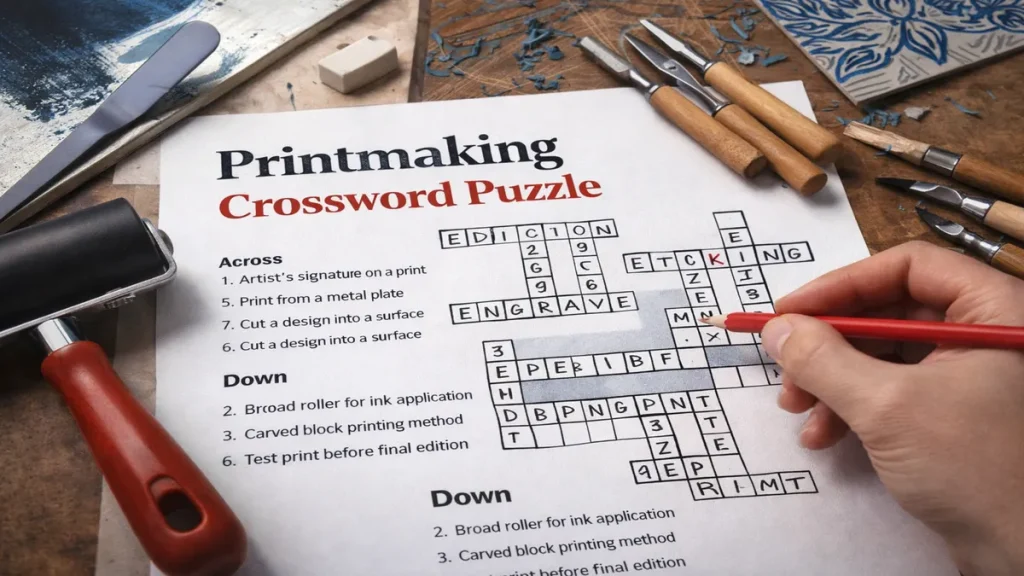
For many people, the phrase “printmaking crossword puzzle” first appears not in a museum or a classroom but in the small white squares of a newspaper grid. A clue like “printmaking, e.g.” or “printmaking process” asks the solver to recall a word, a technique, or even a category of art. In that moment, printmaking becomes not only a visual practice but a linguistic one, a set of terms and ideas that have entered common cultural knowledge deeply enough to be encoded into puzzles. The crossword, in this sense, acts as a bridge between everyday language and specialized artistic vocabulary.
At its simplest, printmaking is the art of creating images by transferring ink from a prepared surface onto another material, most often paper. Unlike painting or drawing, which result in a single unique object, printmaking is defined by its ability to produce multiple impressions from a single matrix. This dual nature, both original and reproducible, is what makes printmaking historically powerful and conceptually rich. It also makes it fertile ground for wordplay, because its techniques, tools, and processes have clear, specific names that fit neatly into the logic of crossword construction.
Understanding printmaking through crossword puzzles offers a way to see how art enters everyday cognition. The solver is not just recalling trivia but activating cultural memory. Terms like etch, press, block, lino, and screen are not random. They represent centuries of artistic practice condensed into a few letters. To solve the clue is to participate, briefly, in a long tradition of image-making and meaning-making.
Printmaking in the Language of Crosswords
Crossword puzzles rely on shared knowledge. Constructors choose words that are recognizable enough to be fair but specific enough to be interesting. Printmaking fits this balance well. It is a broad category, like art or music, but it also contains technical vocabulary that can be used to increase difficulty or thematic depth.
A clue such as “printmaking, e.g.” often leads to a simple answer like ART, signaling that printmaking is part of the fine arts. More advanced puzzles might use clues like “acid-bitten print” to point to ETCHING or “relief print from linoleum” to suggest LINOCUT. In each case, the solver must connect a description to a precise term. This act mirrors what artists themselves do when they learn the craft, matching materials, processes, and results to specific concepts.
Because printmaking has a stable, well-defined vocabulary, it lends itself to this kind of semantic play. Words like INTAGLIO, BRAYER, PRESS, EDITION, and PLATE are both technical and metaphorical, both practical and poetic. The crossword becomes a kind of miniature art history lesson, one clue at a time.
A Short History of Printmaking
Printmaking is older than many people realize. Long before modern printing presses, cultures in East Asia were carving images and texts into woodblocks to reproduce them on silk and paper. This innovation transformed communication, allowing stories, religious texts, and images to circulate beyond the limits of handwriting.
In Europe, printmaking took hold in the fifteenth century with woodcuts and later with metal engraving and etching. Artists like Albrecht Dürer used these techniques not merely for reproduction but for original artistic expression, elevating prints to the status of fine art. The reproducibility of prints meant that images could travel, influencing styles and ideas across borders.
By the nineteenth century, lithography introduced a new approach, allowing artists to draw directly on flat stones or plates using greasy materials that interacted chemically with ink and water. In the twentieth century, screen printing became a major medium, particularly through artists associated with pop art, who used its commercial aesthetic to comment on mass culture. Each of these historical shifts added new terms to the language of printmaking, and those terms eventually found their way into dictionaries, classrooms, and puzzles.
The Major Techniques of Printmaking
Printmaking is commonly divided into several families of techniques, each defined by how the image is created on the matrix and how ink is transferred.
Relief printing works by cutting away areas of a surface so that the raised parts carry ink. Woodcut and linocut are classic examples. The resulting images often have strong contrasts and bold lines.
Intaglio is the opposite. Lines or textures are cut or etched into a surface, and ink sits in these recesses. When paper is pressed onto the plate, it draws the ink out of the grooves. Etching, engraving, and mezzotint belong to this family.
Planographic printing, most famously lithography, relies on chemical principles rather than physical relief or recess. The image is drawn on a flat surface, and ink adheres only to those drawn areas.
Screen printing uses a mesh and stencil system, pushing ink through open areas of the screen onto the printing surface. It is flexible, adaptable, and widely used in both art and industry.
Each of these techniques has generated its own vocabulary, and that vocabulary becomes the raw material of crossword clues.
Printmaking as Cultural Memory
Printmaking is not only a technique but a way of thinking about images. It embodies ideas about repetition, distribution, and access. A single matrix can produce many prints, each technically original but part of a set. This challenges simple ideas of uniqueness and originality.
Crossword puzzles, too, play with repetition and variation. A grid can be filled many times, by many solvers, but each experience is personal. The appearance of printmaking in crosswords thus creates a subtle analogy between the art form and the puzzle itself. Both rely on patterns, both involve transfer, and both depend on the reader or viewer to complete the work.
When a solver encounters a printmaking term, they are not just retrieving a word. They are engaging with a fragment of cultural history, a trace of how humans have made and shared images over time.
Printmaking Vocabulary in Puzzle Form
| Term | Meaning | Why It Appears in Crosswords |
|---|---|---|
| ART | Broad category | Printmaking is a fine art |
| ETCH | To carve with acid | Common intaglio process |
| LINO | Short for linoleum | Relief printing material |
| PRESS | Printing machine | Central tool in printmaking |
This table shows how key terms translate easily into crossword entries, both in length and conceptual clarity.
Techniques and Their Characteristics
| Technique | Surface | Visual Style |
|---|---|---|
| Relief | Raised | Bold, graphic |
| Intaglio | Recessed | Fine, detailed |
| Lithography | Flat | Fluid, drawn |
| Screen printing | Stenciled | Flat, layered |
These distinctions often underpin the logic of clues, helping solvers move from description to answer.
Expert Reflections
Art educators often note that printmaking is one of the most accessible entry points into understanding art processes because it combines design, craft, and experimentation. Linguists point out that its vocabulary is unusually concrete and process-oriented, making it ideal for puzzles and teaching.
Cultural theorists suggest that the persistence of printmaking terms in popular media reflects how deeply the practice has shaped visual communication, even in a digital age. The language remains because the concepts remain useful.
Takeaways
• Printmaking appears in crosswords because it has clear, distinctive vocabulary
• Crossword clues reflect both the art form and its cultural recognition
• Printmaking techniques have evolved over centuries but remain conceptually stable
• Solving such clues reinforces both linguistic and artistic literacy
• The connection between puzzles and printmaking highlights shared patterns of meaning
Conclusion
The printmaking crossword puzzle is more than a playful intersection of art and language. It is a reminder that our everyday entertainments are built on deep cultural foundations. The words we slot into grids carry histories, practices, and ideas that stretch across centuries. When we write ETCH or ART or LINO into a puzzle, we are not just solving a riddle. We are participating in a tradition of making, naming, and sharing meaning.
Printmaking teaches us that images can travel, repeat, and transform while still retaining expressive power. Crosswords teach us that language can do the same. Together, they reveal how human creativity moves between forms, from woodblocks to printing presses to newspaper grids, always finding new ways to leave an impression.
FAQs
What does printmaking mean in a crossword
It usually refers to art techniques like etching or linocut or to the category of art itself.
Why are printmaking terms used in puzzles
They are specific, recognizable, and culturally embedded, making them ideal for clues.
Is printmaking still relevant today
Yes, it remains a vital art form and a key part of visual and cultural history.
Are prints considered original art
Yes, each print is considered an original work, even when produced in editions.
How can learning printmaking help with crosswords
It expands vocabulary and helps recognize technique-based clues.
REFERENCES
- Britannica. (n.d.). Printmaking. Encyclopedia Britannica. https://www.britannica.com/art/printmaking Encyclopedia Britannica
- Merriam-Webster. (2025). Printmaking definition. Merriam-Webster.com Dictionary. https://www.merriam-webster.com/dictionary/printmaking merriam-webster.com
- Wordplays.com. (n.d.). Printmaking crossword clue. Wordplays. https://www.wordplays.com/crossword-solver/printmaking wordplays.com
- WordMint. (n.d.). Printmaking crossword puzzle vocabulary. Wordmint.com. https://wordmint.com/public_puzzles/200424 wordmint.com
- CrosswordLabs. (n.d.). Printmaking crossword. Crosswordlabs.com. https://crosswordlabs.com/view/printmaking-crossword4