

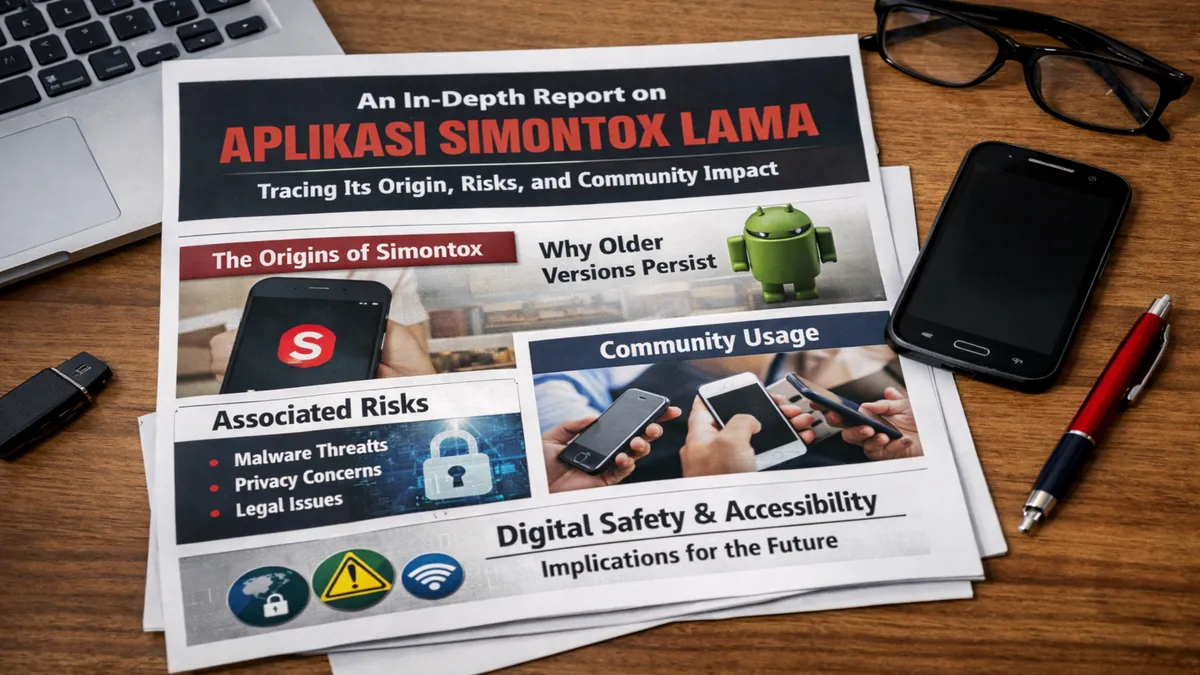
People who search for aplikasi simontox lama are usually not looking for innovation. They are looking for continuity. They want something familiar, lightweight, and predictable in a mobile world that changes faster than many users can comfortably follow. The phrase refers to older versions of applications commonly known as Simontox or Simontok, which circulated widely in earlier Android ecosystems and still live on through community sharing and third-party archives.
These older versions are often smaller, simpler, and easier to run on aging phones. For many users, especially those with limited storage, slower processors, or inconsistent internet access, the newest version of an app can feel heavy, complicated, or unnecessary. The old version becomes a form of digital comfort. It represents a time when software felt manageable, when updates were rare, and when the device belonged more fully to the user.
Yet this preference for older software is not just technical. It reflects a deeper pattern in how people relate to technology. Users are not only choosing code; they are choosing control, familiarity, and autonomy. Aplikasi simontox lama becomes a way of resisting constant change and reclaiming a sense of ownership over one’s digital environment. This article explores how that choice emerged, what it says about mobile culture, and what risks and responsibilities accompany it.
The early ecosystem of Simontox
In its earliest form, Simontox was one of many lightweight Android applications that emerged during a period when mobile internet was expanding rapidly but hardware remained limited. Apps were designed to be small, fast, and adaptable. Features were minimal. Interfaces were simple. The goal was not elegance but accessibility.
These early versions worked well on Android 4 and 5 devices, which were common across Southeast Asia for many years. They loaded quickly, consumed little data, and did not rely on heavy background services. For users accustomed to prepaid data plans and unstable connections, this mattered.
Over time, as Android matured and app stores tightened their policies, newer versions became more complex. They integrated analytics, monetization layers, and compliance mechanisms. The old versions, by contrast, remained frozen in time, preserved by users who preferred their simplicity.
Why users keep returning to the old versions
There are practical reasons why older versions persist. Older phones struggle with modern software. Storage is limited. Memory is scarce. Battery life is precious. A lightweight app can feel like a gift in such conditions.
There are emotional reasons as well. Technology carries memory. An old app is associated with a period in someone’s life, with particular routines, habits, or social circles. Keeping the old version is a way of preserving that continuity. It is not unlike preferring an older car model or a familiar notebook.
There is also a philosophical reason. Installing an old APK manually feels like an assertion of agency. It bypasses centralized control. It says, “I choose what runs on my device.” That feeling of autonomy is powerful, especially in a digital environment increasingly shaped by algorithms, policies, and invisible rules.
What legacy software offers in comfort, it often lacks in protection. Older applications were built before modern security standards became common. They are not regularly patched. They may contain vulnerabilities that are now well understood and easily exploited.
When users download these apps from unofficial sources, another layer of risk is added. There is no guarantee that the file is authentic. It may have been modified. It may contain malicious code. The user has no simple way to verify this.
Privacy is another concern. Older apps may request broad permissions or transmit data insecurely. In an era of increased awareness about data misuse, these blind spots matter.
The culture of sideloading
The persistence of aplikasi simontox lama reflects a broader culture of sideloading. In many regions, users have long been accustomed to installing apps outside official stores. This practice grew from necessity, not rebellion. Official stores were incomplete, restrictive, or inaccessible. Sideloading filled the gap.
Over time, this practice became normalized. Communities formed around sharing files, recommending versions, and troubleshooting installations. Trust shifted from institutions to peers.
This culture values flexibility and access, but it also shifts responsibility from the platform to the individual. The user becomes their own security team, often without the tools or knowledge to fulfill that role fully.
A comparison of old and new
| Aspect | Legacy version | Modern version |
|---|---|---|
| Size | Small | Larger |
| Compatibility | Older devices | Newer devices |
| Updates | Rare | Frequent |
| Security | Weak | Stronger |
| Control | User-driven | Platform-driven |
| User priority | Outcome |
|---|---|
| Familiarity | Choose old |
| Safety | Choose new |
| Autonomy | Choose old |
| Support | Choose new |
Expert perspectives
“People do not resist updates because they hate progress. They resist because progress often ignores their constraints.”
“Legacy software is not a technical failure. It is a social response to uneven technological change.”
“Security is invisible when it works, and painfully visible when it fails.”
Keeping an old app is a quiet form of resistance. It resists planned obsolescence. It resists constant change. It resists the idea that newer is always better.
But it is also a negotiation. Users trade safety for comfort, protection for control, and support for familiarity. This is not irrational. It reflects the priorities of people whose lives are shaped by constraints that technology designers do not always see.
Takeaways
- Aplikasi simontox lama represents legacy mobile culture.
- Users choose old versions for simplicity and familiarity.
- Older software carries higher security and privacy risks.
- Sideloading culture values autonomy over protection.
- Technology choices reflect social and emotional needs.
- Digital literacy must include understanding trade-offs.
Conclusion
The story of aplikasi simontox lama is not really about an app. It is about how people live with technology. It is about how they negotiate between change and continuity, safety and freedom, convenience and control.
Older software persists because it fits into real lives with real constraints. It is chosen not because it is best, but because it is good enough, familiar, and manageable.
Understanding this helps us see technology not as a linear march forward, but as a landscape of overlapping timelines, where old and new coexist, and where users constantly balance risk, comfort, and agency.
FAQs
Apa itu aplikasi simontox lama?
Itu merujuk pada versi lama dari aplikasi Simontox atau Simontok.
Kenapa orang masih menggunakannya?
Karena lebih ringan, familiar, dan cocok untuk perangkat lama.
Apakah aman digunakan?
Lebih berisiko dibanding versi baru karena kurang pembaruan keamanan.
Apa itu sideloading?
Menginstal aplikasi dari luar toko aplikasi resmi.