

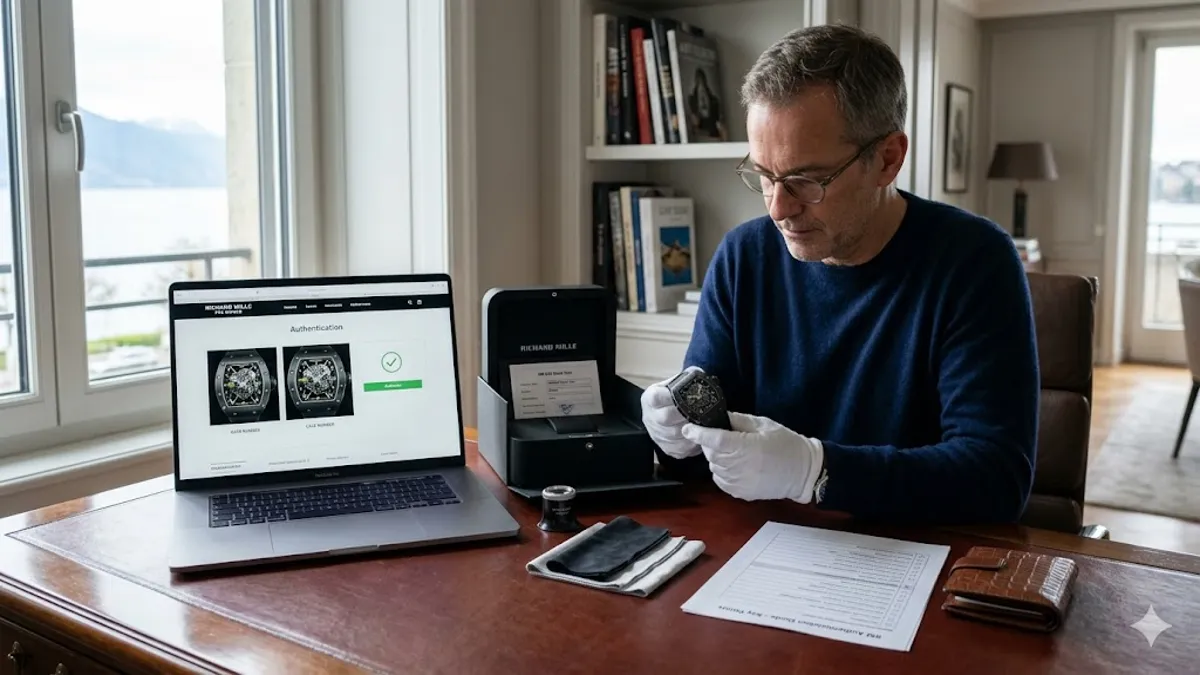
A counterfeit Richard Mille can sell for $500. The real thing starts at around $80,000 and climbs well past $2 million for the rarest references. That gap is exactly why the pre-owned Richard Mille market attracts more fraud than almost any other category in luxury goods.
Unlike vintage Rolex or even Patek Philippe, Richard Mille watches are relatively young as a brand, which means buyers often have less institutional knowledge to fall back on. The cases are complex, the movements are unlike anything else in watchmaking, and the fakes, in some cases, are startlingly convincing at first glance. Shopping online adds another layer of risk on top of all of that.
This guide is for anyone seriously considering buying a Richard Mille on the secondary market through an online channel. Whether you’re after an RM 11-03, an RM 27, or something rarer, the process of protecting yourself is the same.
Why Richard Mille Is Such a High-Risk Category
Richard Mille didn’t exist until 2001. In just over two decades, the brand built a waiting list culture, a celebrity following, and a secondary market where prices routinely exceed retail. That trajectory made it a target.
The counterfeit problem is well-documented. Publications like Hodinkee and A Blog to Watch have both covered the sophistication of replica Richard Milles, particularly from high-volume manufacturing operations that produce “super clones” with multi-layer cases and skeletonised dials that photograph convincingly.
Beyond outright fakes, there’s also the issue of frankensteined pieces, genuine cases fitted with non-original or replaced movements, dials, or skeletons. These aren’t technically counterfeits, but they’re misrepresented and their value is fundamentally different from an unaltered original.
The online environment amplifies all of this. Still photography can hide condition issues, replaced parts, and finishing inconsistencies. A listing with ten polished images tells you almost nothing about what you’re actually getting.
How to Vet a Seller Before You Send a Single Dollar
The seller matters more than the listing. A convincing set of photos from an unverified source is essentially worthless as a buying signal. Here’s how to approach due diligence properly.
Check for Physical Presence
Legitimate dealers in the high-end pre-owned space typically have a physical address, ideally a boutique or office you could actually visit. A seller operating entirely through DMs, a freshly created social profile, or a personal PayPal account is a serious red flag at this price point.
This isn’t about being unfair to independent sellers. It’s about risk-appropriate verification. When you’re spending $150,000 on a watch, “they seemed trustworthy online” is not a defence.
Look for Verifiable Transaction History
Established dealers have a track record. Look for:
- Press coverage in credible publications (Robb Report, Haute Time, A Blog to Watch)
- Verified reviews on Google, Trustpilot, or Chrono24
- Membership with industry bodies like the AWCI or equivalent
- A clear, documented returns and authentication policy
If none of that exists, the burden of proof shifts entirely onto the buyer. That’s not a position you want to be in.
Understand the Return Policy Before Anything Else
A reputable dealer will offer a return window and explicit authentication guarantees. If the policy is vague, buried in fine print, or absent, treat that as a hard stop. No legitimate seller of a $200,000 timepiece should object to giving you the ability to walk away if a third-party authentication fails.
What to Ask For Before Agreeing to Purchase
Once you’ve established baseline trust in the seller, the documentation and verification process is where you protect yourself on the watch itself.
Request the Full Box and Papers
For Richard Mille, the original box set, certificate of authenticity, and papers are not just nice to have. They have a meaningful impact on resale value and on authenticity verification. Be wary of any listing that describes the papers as “lost” or the box as “misplaced” without a convincing explanation.
This is especially true for newer references. A 2020 RM 11-03 without box and papers should prompt genuine questions.
Ask for a Video Walkthrough
Photos can be doctored, borrowed, or taken from other listings. A video, particularly one that shows the crown, caseback, movement through the sapphire, and the physical weight and proportions of the piece, is significantly harder to fake convincingly.
Ask the seller to record specific details on request, the serial number area, the clasp engravings, and the movement finishing under natural light. If they refuse or delay, that tells you something.
Request the Service History Where Applicable
Older Richard Mille references may have passed through authorised service. Richard Mille’s own service centres are limited in number, and documented service from an authorised point is a positive authenticity signal. It doesn’t prove the watch is genuine on its own, but it adds a layer of verified provenance.
Third-Party Authentication: Non-Negotiable at This Price Point
For any Richard Mille purchase above $50,000, which is most of them, independent authentication should be part of the deal structure, not an afterthought.
Several options exist:
- Watchfinder’s authentication programme and similar established specialists
- SSIH-certified watchmakers with specific Richard Mille experience
- In-person inspection appointments at a reputable dealer’s boutique before funds are released
If you’re buying remotely, some dealers will ship to a trusted third-party watchmaker for inspection before final payment is processed. Any seller who won’t accommodate a legitimate authentication request before you pay in full should be avoided without exception.
This is where working with an established specialist matters. For example, buyers who choose to shop Richard Mille watches online through Wrist Aficionado benefit from an authentication guarantee built into every transaction, removing the need to arrange independent verification separately.
Payment Methods and Purchase Protection
How you pay determines what recourse you have if something goes wrong.
Bank wire is standard for high-value watch transactions, but it offers no consumer protection once the funds clear. For a first-time purchase with a dealer you haven’t transacted with before, explore whether they accept credit card payment for part or all of the amount. Many premium dealers do, and the chargeback protection is meaningful.
Cryptocurrency payments, while increasingly common in luxury goods, offer essentially zero recourse. Avoid these unless you have an established relationship with the seller and a watertight written agreement in place.
Always get the full terms in writing before any funds move. That includes the item description, authenticity guarantee, return window, and shipping terms.
Red Flags That Should Stop You in Your Tracks
Some warning signs are subtle. Others are not. Here’s a practical list of what should make you pause or walk away:
- Price significantly below current market value with no clear explanation
- Seller pressure to complete the transaction quickly
- Photos that appear lifted from other listings or lack consistent lighting
- No verifiable physical location or business history
- Resistance to third-party authentication before payment
- Vague or absent returns and authenticity policy
- Payment via wire only to a personal account, not a business entity
- Serial number that the seller is unwilling to provide in advance
None of these individually guarantees fraud. Together, they paint a picture worth paying attention to.
Finding Reputable Sources for Pre-Owned Richard Mille
The pre-owned luxury watch market has matured considerably in the last decade. Platforms like Chrono24 offer seller ratings and buyer protection programmes, which provide some baseline screening. But they’re marketplaces, not curators. The quality of inventory varies enormously.
For Richard Mille specifically, working with a specialist dealer who has deep inventory and verifiable authentication processes is the most reliable route. A resource like Wrist Aficionado, where you can shop Richard Mille watches online through a catalogued, authenticated inventory with boutique locations in New York, Miami, and Beverly Hills, offers the kind of structure that reduces risk meaningfully for buyers operating remotely.
The combination of physical presence, documented authentication, and a consistent track record in the market is the closest thing to a safety net that the pre-owned space provides.
Key Takeaways
- Verify the seller’s physical presence, transaction history, and authentication policy before anything else
- Request video walkthroughs, serial numbers, and box and papers documentation upfront
- Insist on third-party authentication before releasing funds on any Richard Mille purchase
- Pay with methods that offer recourse where possible, and get all terms in writing
- Work with specialist dealers who have verifiable reputations and physical locations, not anonymous online sellers
Frequently Asked Questions
How do I know if a Richard Mille is authentic from photos alone? You largely can’t, and that’s the point. Photos are easy to manipulate or misrepresent. Authentication requires physical inspection of the movement, case finishing, engravings, and proportions. Use photos as a first filter only, then require a video and, ideally, hands-on verification.
Are Richard Mille fakes actually convincing? Some of the high-end replicas are convincing enough to fool casual buyers and even some non-specialist dealers. The movement internals, sapphire caseback clarity, and weight distribution are usually where genuine pieces diverge from counterfeits, but catching this requires expertise.
Is it safe to buy a Richard Mille on Chrono24? Chrono24 has a buyer protection programme and verified seller ratings, which adds some structure. But the platform hosts both private sellers and professional dealers, and the level of authentication varies by listing. Research the specific seller and don’t rely on platform trust alone at this price point.
Do I need box and papers for a Richard Mille to be worth buying? Not necessarily, but it affects value significantly. A complete set with original box and papers can command a notable premium at resale. More importantly for authenticity purposes, original paperwork adds a layer of provenance that a stripped piece lacks.
What’s the most common scam in the online Richard Mille market? The most common scenario is a listing that looks legitimate, uses real photographs, and asks for a wire transfer. Once the funds clear, the watch either never arrives or arrives as a convincing replica. The protection is simple: work with verified dealers who have physical addresses and documented authentication processes.
Conclusion
Buying a Richard Mille online doesn’t have to be a gamble, but it requires a level of diligence that most consumer purchases simply don’t demand. The combination of high prices, limited supply, and a sophisticated counterfeit market means that cutting corners in the verification process is genuinely expensive when it goes wrong.
The framework here isn’t complicated. Verify the seller first. Document everything. Insist on authentication before funds move. And when in doubt, work with a specialist who has skin in the game and a reputation worth protecting. That combination eliminates most of the risk, and the watch you end up with will be worth exactly what you paid for it.
 admin
admin