

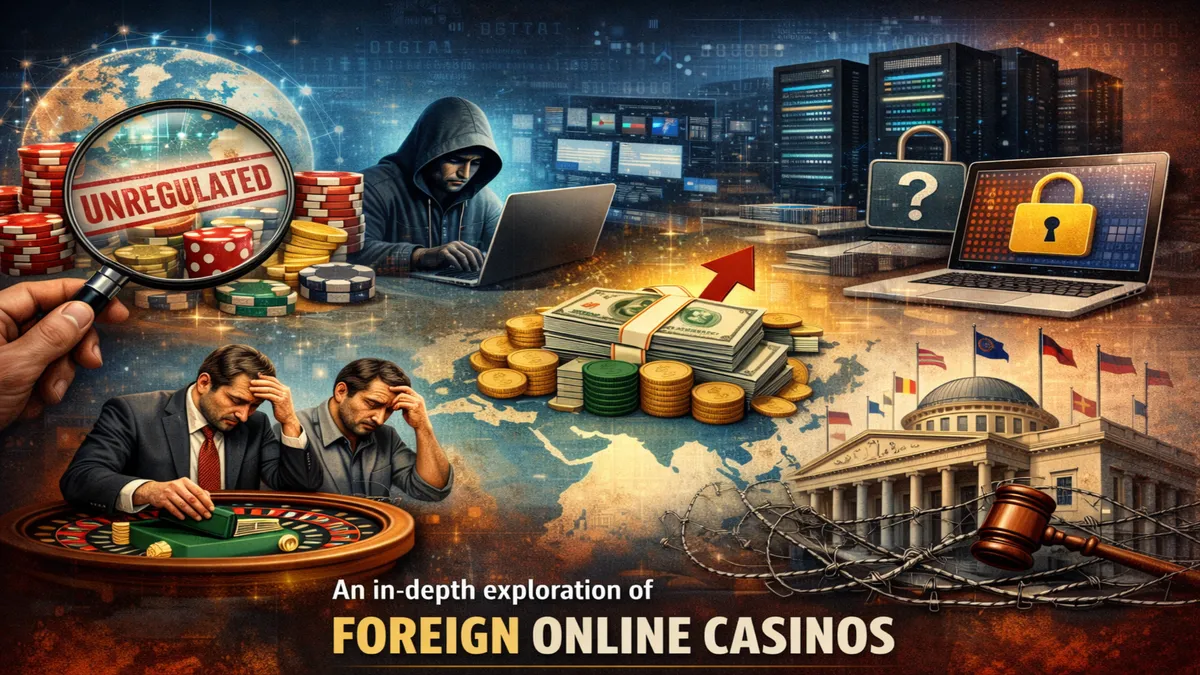
The phrase “online casino buitenland” has quietly become one of the most searched combinations in parts of Europe, especially in the Netherlands. It literally means “online casino abroad,” and it reflects a growing curiosity — and sometimes a deliberate choice — among players to look beyond their own national gambling markets. When users type this phrase into a search engine, it is often followed by unfamiliar domains such as storemicgadget.com, a site that appears not as a casino itself but as a gateway, a referral layer, and a traffic funnel into a wider offshore gambling ecosystem. – online casino buitenland www.storemicgadget.com.
For the average user, this ecosystem is opaque. The search result looks harmless: a list of casinos, some promotional language, perhaps a comparison table or bonus offer. But beneath this surface sits a complicated web of affiliate marketing, regulatory gaps, digital arbitrage, and economic incentives that stretch across borders and legal systems. What looks like a simple consumer choice — clicking on a foreign casino link — is in fact participation in a global market that is only partially regulated, unevenly enforced, and often poorly understood by the people inside it.
This article examines what “online casino buitenland” really represents, why sites like storemicgadget.com exist, how they function, and what risks and consequences they introduce. It is not a story about villains and victims, but about systems: the system of online advertising, the system of gambling regulation, and the system of incentives that push companies and players into spaces where the rules are unclear. Understanding that system is the first step toward understanding why offshore gambling continues to grow — even as governments attempt to rein it in. – online casino buitenland www.storemicgadget.com.
The meaning behind “online casino buitenland”
At its core, “online casino buitenland” is a workaround phrase. It emerges when domestic gambling markets become more regulated, more restricted, or more controlled. In the Netherlands, for example, legal online gambling is tightly supervised, with mandatory player verification, spending limits, advertising restrictions, and self-exclusion mechanisms. These safeguards are designed to protect consumers, prevent addiction, and limit harm.
But regulation always has a side effect: it creates friction. Friction for operators, who must comply with costly rules, and friction for players, who may feel constrained by limits or excluded entirely through self-exclusion systems. The phrase “online casino buitenland” expresses a desire to bypass that friction by looking elsewhere — toward casinos licensed in other countries, operating under different standards, and reachable with a few clicks.
This does not necessarily mean that users are seeking something illegal. Often, they are seeking something less constrained: fewer identity checks, higher bonuses, no local self-exclusion databases, or simply novelty. The term reflects not criminal intent but regulatory arbitrage — the exploitation of differences between legal systems.
What storemicgadget.com represents
Storemicgadget.com does not present itself as a gambling operator. It appears instead as an intermediary: an affiliate site that attracts traffic using specific keywords and then redirects users to third-party casinos. This is a common model in online marketing. The site earns a commission for each referred player, usually based on how much that player wagers or loses.
What makes storemicgadget.com notable is not its uniqueness, but its typicality. It is part of a broader pattern in which expired or underused domains are repurposed to capture search traffic. The domain name itself does not suggest gambling, which can give it an air of neutrality or even legitimacy. Yet its content and search associations connect it directly to casino referrals.
This structure allows the affiliate to remain legally and reputationally distant from the gambling activity itself. The casino takes the regulatory and operational risks; the affiliate takes the marketing role and monetizes attention. – online casino buitenland www.storemicgadget.com.
The affiliate economy of gambling
Affiliate marketing is the hidden infrastructure of the online gambling world. Most players do not arrive at casinos by typing the casino’s name directly into their browser. They arrive through lists, reviews, comparison sites, and “best of” articles that promise to help them choose.
These affiliate sites compete intensely for search rankings. They use search engine optimization, keyword targeting, and sometimes grey-area techniques to insert themselves into the user’s path. “Online casino buitenland” is one such keyword cluster. It is valuable because it signals high intent: the user is not browsing casually; they are actively looking for a casino outside their domestic system.
The economic incentives are powerful. A single high-value player can generate thousands of euros in affiliate commissions over time. That reward drives the proliferation of sites like storemicgadget.com and encourages experimentation with domain strategies, content repurposing, and algorithmic manipulation.
Regulation and its unintended consequences
Governments regulate gambling for good reasons: to prevent addiction, protect minors, reduce fraud, and ensure fair play. But regulation also reshapes markets. When legal domestic markets become more restrictive, offshore markets become more attractive by comparison.
This does not mean regulation is wrong. It means regulation creates pressure. That pressure pushes both operators and consumers into alternative channels. Offshore casinos can offer higher bonuses because they face lower compliance costs. They can accept players who are excluded domestically. They can operate from jurisdictions with lighter oversight. – online casino buitenland www.storemicgadget.com.
The result is a split market: a regulated, visible one at home, and a less regulated, less visible one abroad.
Risks for players
The risks of offshore gambling are not always obvious, but they are real.
Data privacy is one risk. Domestic operators in Europe are bound by strict data protection rules. Offshore operators may not be, or may operate under weaker regimes.
Fairness is another risk. Licensed operators are audited; their games are tested. Offshore operators may be honest, but the player has less assurance.
Dispute resolution is a third risk. If a domestic casino refuses to pay, the player can complain to a regulator. If an offshore casino does the same, the player’s options are limited.
Finally, there is the risk of harm escalation. Without enforced limits or self-exclusion systems, players who struggle with gambling may find it easier to lose control.
Why players still go offshore
Despite these risks, players continue to seek offshore casinos. The reasons are not mysterious.
Some want anonymity. Some want bigger bonuses. Some want access after being excluded domestically. Some simply want variety.
Others distrust domestic systems, seeing them as intrusive or paternalistic. Offshore casinos promise freedom, even if that freedom comes with fewer protections.
The growth of offshore gambling has implications beyond individual players.
It undermines domestic regulatory goals by pulling activity out of supervised systems.
It complicates taxation, as revenue flows to foreign jurisdictions.
It creates enforcement challenges, as regulators struggle to police advertising and access across borders.
And it reshapes the gambling industry itself, incentivizing operators to move or license in more permissive jurisdictions.
Structured comparison
| Aspect | Domestic licensed casinos | Offshore casinos via affiliates |
|---|---|---|
| Regulation | Strong, enforced locally | Variable, often weaker |
| Player limits | Mandatory | Often absent |
| Data protection | High | Uncertain |
| Dispute resolution | Available | Limited |
| Marketing transparency | Regulated | Often opaque |
| Stakeholder | Incentive |
|---|---|
| Affiliate | Maximize traffic and conversions |
| Offshore operator | Acquire players cheaply |
| Player | Seek freedom, bonuses, access |
| Regulator | Protect consumers, enforce rules |
Expert perspectives
“Affiliate marketing doesn’t create gambling demand; it redirects it,” says a digital economy researcher. “The question is not whether people will gamble, but where and under what conditions.”
A legal scholar adds: “Offshore gambling exists because legal systems stop at borders, but the internet doesn’t. That mismatch is structural.”
A public health expert warns: “When safeguards are removed, harm doesn’t disappear — it just becomes harder to see.”
Takeaways
- “Online casino buitenland” reflects a search for gambling outside domestic regulation.
- Storemicgadget.com is an example of an affiliate site monetizing that search intent.
- Affiliate marketing is the main traffic engine behind offshore gambling.
- Regulation protects players but also pushes some toward less regulated spaces.
- Offshore casinos offer freedom but fewer protections.
- The system persists because incentives align for affiliates, operators, and some players.
Conclusion
The story of storemicgadget.com and “online casino buitenland” is not about a single website or a single market. It is about how digital systems adapt to regulation, how incentives reshape behavior, and how borders lose meaning online. Offshore gambling is not a glitch in the system; it is a product of the system.
As long as gambling remains legal somewhere and restricted elsewhere, people will move across those boundaries — digitally if not physically. The challenge for regulators is not simply to block access, but to understand why users leave regulated spaces in the first place. The challenge for players is to understand what they give up when they do. – online casino buitenland www.storemicgadget.com.
The internet has made choice abundant, but it has also made responsibility diffuse. In the world of online gambling, that diffusion leaves many players navigating risk alone, guided less by law than by algorithms, and less by protection than by promotion.
FAQs
What does “online casino buitenland” mean?
It refers to online casinos based outside a user’s home country.
Is storemicgadget.com a casino?
It appears to function as an affiliate referral site, not a gambling operator.
Are offshore casinos illegal?
They are often legal in their own jurisdictions but unlicensed in the player’s country.
Why do people use offshore casinos?
For fewer restrictions, higher bonuses, or access after domestic exclusion.
Are offshore casinos unsafe?
Not always, but they generally offer fewer protections and guarantees.
 Luys Parker