

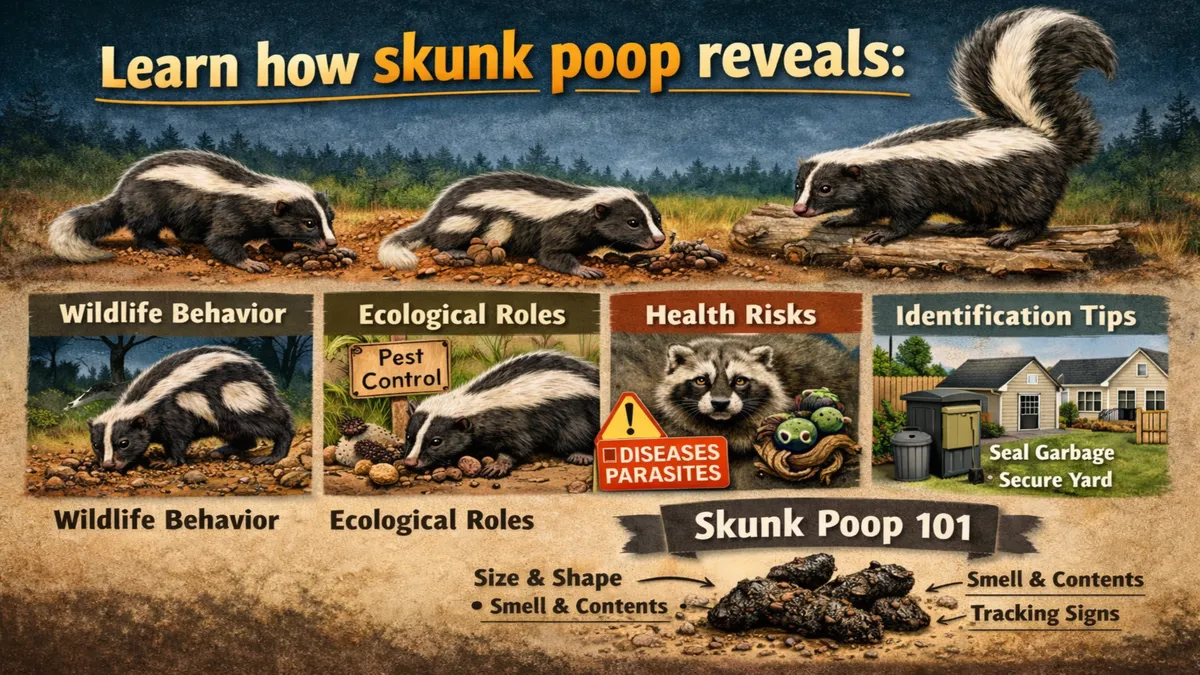
Skunk poop is an unlikely but surprisingly informative subject. To homeowners, it is often an unpleasant discovery on a lawn or near a garden bed. To wildlife biologists, veterinarians, and ecologists, however, it is a compact record of an animal’s diet, health, movement patterns, and relationship with its environment. In the first 100 words, the value of understanding skunk poop becomes clear: it helps identify skunk activity, distinguish skunks from other animals, assess disease risk, and interpret how skunks are adapting to urban and suburban spaces.
Skunks are highly adaptable mammals that thrive across forests, grasslands, farms, and neighborhoods. As human development expands into natural habitats, skunks increasingly live alongside people, feeding on insects, small animals, fruit, pet food, and garbage. Their droppings reflect these changes, containing traces of what they eat and where they have been. By learning what skunk poop looks like, where it appears, and what it contains, people can better understand how wildlife is using their space and how to coexist more safely and responsibly.
This article explores skunk poop as a biological signal rather than just a nuisance. It examines how to identify it, what it reveals about skunk behavior and health, the risks and benefits it represents for ecosystems, and what it tells us about the broader relationship between wildlife and human settlement. In doing so, it shows how even the most humble traces of animal life can offer insight into environmental change, biodiversity, and the hidden systems that connect human and non-human worlds.
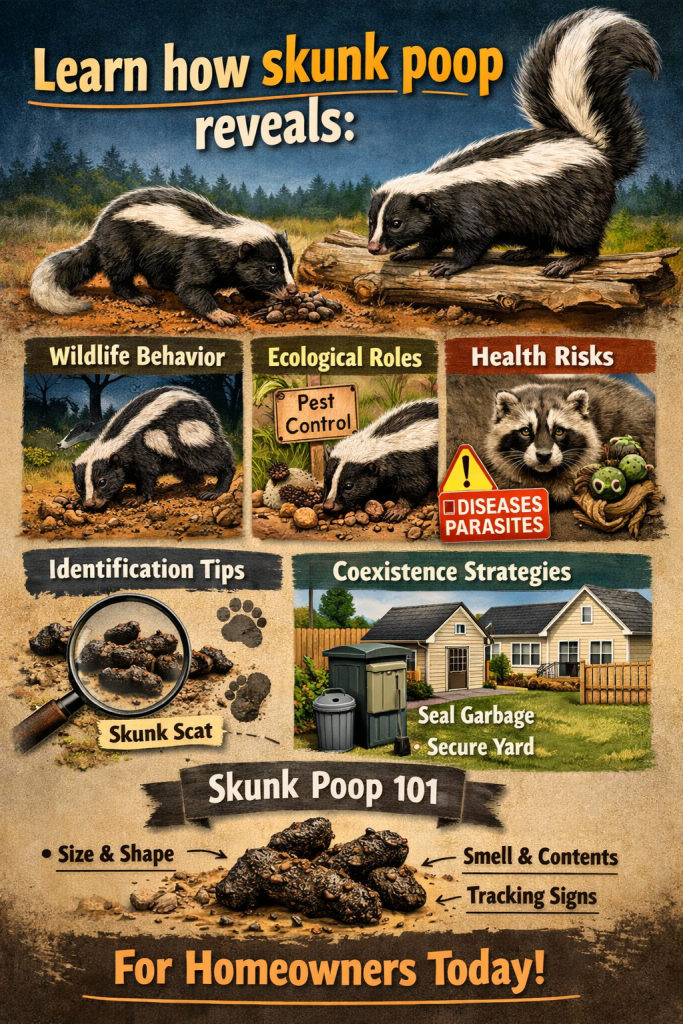
What Skunk Poop Looks Like and How to Identify It
Skunk poop is typically tubular, about two to three inches long, and slightly tapered at the ends. It is often dark brown or black and may contain visible fragments of insect exoskeletons, seeds, berries, or fur from small prey. Its size and shape can resemble raccoon or opossum droppings, but skunk scat is usually smaller and less segmented.
The location of the droppings is often as telling as their appearance. Skunks tend to defecate near feeding areas, den sites, or along regular travel routes. Lawns with grubs, gardens with fallen fruit, and areas near garbage cans are common spots. Unlike some animals, skunks do not usually create communal latrines, so their droppings are more scattered.
Smell is another clue. Skunk poop can have a strong, musky odor, especially when fresh, reflecting the animal’s distinctive scent glands and diet. While not as intense as a spray, the smell can linger, particularly in warm weather.
Identifying skunk poop correctly matters because it informs decisions about cleanup, exclusion, and health precautions. Mistaking it for dog or raccoon feces can lead to inappropriate handling or misdirected control efforts.
What Skunk Poop Reveals About Diet and Behavior
Skunks are omnivores with highly flexible diets. Their droppings often contain insect parts, such as beetle shells or grasshopper legs, reflecting their role as natural pest controllers. They also eat earthworms, small rodents, eggs, carrion, fruit, and human food waste when available.
Seasonal variation is visible in their poop. In spring and summer, insect fragments dominate. In autumn, seeds, berries, and fruit skins become more common. In winter, when food is scarce, droppings may contain more fur and bone from small mammals or scavenged remains.
This dietary flexibility explains why skunks are so successful in human-dominated landscapes. They can exploit lawns, gardens, compost piles, and trash while still relying on natural prey. Skunk poop thus becomes a record of human impact on wildlife diets and the permeability of the boundary between natural and built environments.
Skunk Poop and Ecosystem Function
Though rarely appreciated, skunk poop plays a role in nutrient cycling and seed dispersal. By consuming fruit and berries and depositing seeds elsewhere, skunks contribute to plant propagation. Their droppings also return nitrogen and other nutrients to the soil, supporting microbial and plant life.
In this sense, skunks function as ecological connectors. They move nutrients and energy across spaces, linking forests to fields, gardens to wild areas. Their poop is a vehicle for that movement, transporting organic matter and microorganisms.
Ecologists note that animals like skunks help maintain ecosystem resilience by filling multiple roles: predator, scavenger, seed disperser, and soil fertiliser. Skunk poop is the physical trace of that multifunctionality.
Health and Disease Considerations
Skunk poop can carry pathogens, including parasites and bacteria that pose risks to humans and pets. Roundworms, leptospirosis, and other zoonotic agents can be present. For this reason, it should never be handled with bare hands.
Drying reduces but does not eliminate risk. People cleaning skunk droppings should use gloves, avoid creating dust, and wash hands and tools thoroughly afterward. Pets should be prevented from sniffing or eating animal feces, which can transmit disease.
Veterinarians emphasize that most risks are manageable with basic hygiene and awareness. Panic is unnecessary, but caution is appropriate. Understanding skunk poop is part of understanding how to live safely alongside wildlife.
Skunks in Urban and Suburban Landscapes
The increasing presence of skunks in cities and suburbs reflects broader trends in wildlife adaptation. As predators decline and green spaces fragment, generalist species like skunks thrive. They find food in lawns, shelter under decks, and water in irrigation systems.
Skunk poop in a yard is therefore not just an isolated event but a sign of ecological change. It indicates that the landscape has become suitable for skunks, often because it offers abundant food and low risk.
Some people view this as a problem; others see it as evidence of urban biodiversity. Both perspectives are valid. The challenge is to balance human comfort and safety with respect for wildlife.
Comparison of Skunk Poop With Other Common Wildlife Droppings
| Animal | Typical Size | Shape | Common Contents |
|---|---|---|---|
| Skunk | 2–3 inches | Tubular, tapered | Insects, seeds, fur |
| Raccoon | 3–5 inches | Segmented | Fruit, grains, bones |
| Opossum | 1–2 inches | Curved, smooth | Insects, fruit |
| Fox | 2–4 inches | Twisted, pointed | Fur, feathers |
| Feature | Skunk | Raccoon | Dog |
|---|---|---|---|
| Latrine behavior | No | Yes | No |
| Odor | Musky | Mild | Variable |
| Typical location | Lawns, gardens | Base of trees | Random |
These comparisons help homeowners identify the source of droppings and respond appropriately.
Expert Perspectives
Wildlife biologist Dr. Karen Lewis notes that “animal droppings are one of the most reliable non-invasive ways to study wildlife presence and behavior.” She emphasizes that scat analysis reveals diet, movement, and population health without disturbing animals.
Veterinarian Dr. Miguel Alvarez explains that “most disease risks from wildlife feces are preventable with simple hygiene, but awareness is essential, especially for children and pets.”
Urban ecologist Dr. Hannah Wu adds that “the appearance of animals like skunks in cities reflects both ecological resilience and human landscape design. Their presence tells us as much about us as about them.”
Cultural and Psychological Responses
Human reactions to skunk poop range from disgust to curiosity. This reflects deeper attitudes toward nature. In many cultures, animal waste is seen as dirty and threatening, symbolizing disorder. In ecological thinking, however, it represents continuity and life cycles.
Recognizing this tension can help shift perspectives. Instead of seeing skunk poop solely as a problem, people can view it as a sign of living systems intersecting with human ones. This does not mean ignoring inconvenience or risk, but contextualizing it.
Takeaways
- Skunk poop is identifiable by size, shape, contents, and location.
- It reflects skunk diet, health, and adaptation to human environments.
- It plays a role in nutrient cycling and seed dispersal.
- It carries manageable but real health risks.
- Its presence signals broader ecological and urban trends.
Conclusion
Skunk poop is a small, often unwelcome presence that carries a surprisingly large amount of information. It tells a story about what skunks eat, where they travel, how they survive, and how they interact with human-altered landscapes. It connects backyard lawns to insect populations, fruiting plants, soil microbes, and disease cycles.
Understanding skunk poop does not mean celebrating it, but it does mean recognizing its place in the larger system of life. By paying attention to such traces, people can become more literate in the language of ecology that surrounds them every day.
In an era of environmental change and increasing human–wildlife contact, such literacy matters. It helps reduce fear, prevent harm, and foster coexistence. Skunk poop, humble as it is, becomes a reminder that even the least glamorous parts of nature play a role in sustaining the world we share.
FAQs
How can I tell if poop is from a skunk?
Look for tubular droppings about 2–3 inches long with insect parts or seeds.
Is skunk poop dangerous?
It can carry pathogens, so avoid direct contact and practice hygiene.
Why is skunk poop in my yard?
Your yard likely offers food or shelter attractive to skunks.
Can skunk poop help my garden?
It adds nutrients but should not be used deliberately as fertilizer.
How can I reduce skunk visits?
Remove attractants like fallen fruit, grubs, and unsecured trash.
 Prime Star