

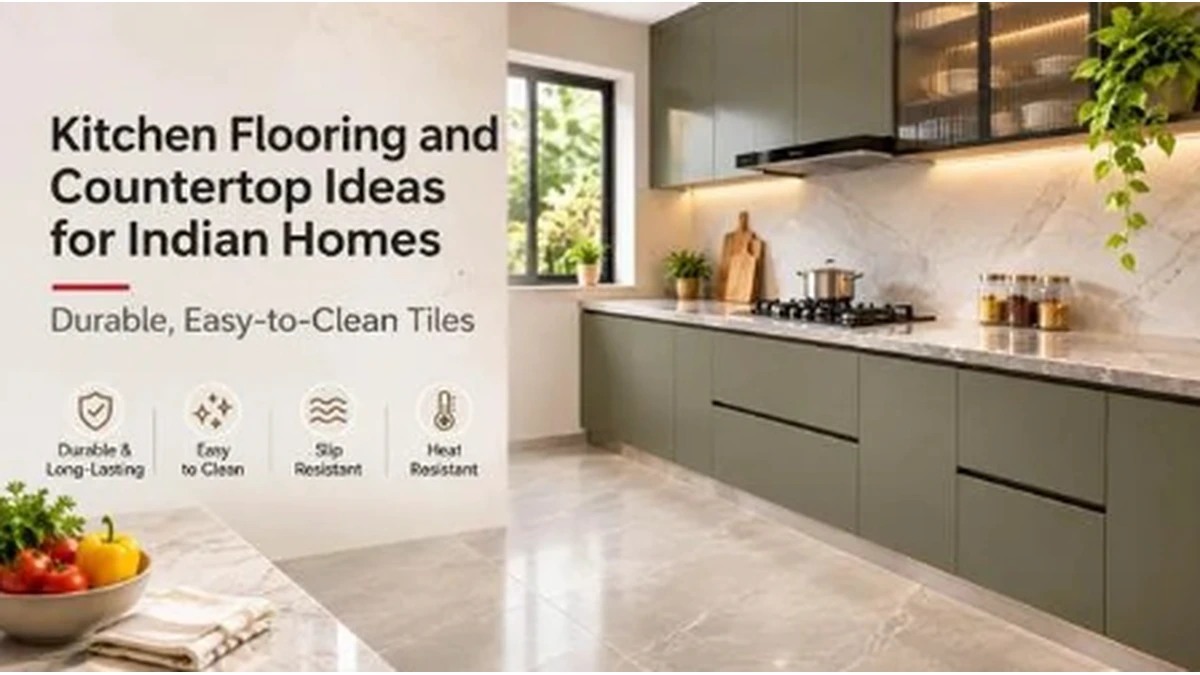
Summary: The Indian kitchen works harder than almost any other room in the home. High heat, heavy spices, frequent splashes, and daily scrubbing are simply part of the territory. Choosing the right kitchen floor tile design and countertop surface is not just an aesthetic decision. It is a practical one that determines how much time you spend cleaning, how long your kitchen looks good, and how well it holds up to decades of real Indian cooking.
Table of Contents
- What Makes a Great Kitchen Tile for Indian Homes
- Kitchen Floor Tile Ideas
- Kitchen Flooring Options: A Comparison
- Kitchen Countertop Tile Designs and Ideas
- Easy-to-Clean Kitchen Tiles: What to Look For
- Practical Tips Before You Buy
- Frequently Asked Questions
Key Takeaways
● Kitchen floor tile ideas for Indian homes must prioritise durability, slip resistance, and easy cleaning alongside aesthetics. The Indian kitchen demands more from surfaces than most
● Kitchen floor tiles design trends in India are moving toward large-format tiles, wood-look finishes, and matte surfaces that hide dust and minor stains effectively
● Kitchen flooring options range from vitrified and ceramic tiles to natural stone, and hardwood-look porcelain, each with specific advantages and limitations
● Kitchen countertop tile designs in India increasingly favour granite-look porcelain, subway tiles, and full-slab designs that are heat-resistant, stain-resistant, and genuinely easy to wipe clean
● Easy-to-clean kitchen tiles share specific characteristics- low porosity, a smooth or slightly textured surface, and minimal grout lines- that make daily maintenance significantly less demanding
● Large-format tiles (1200x1800mm and above) dramatically reduce grout lines. The primary maintenance challenge in any tiled kitchen surface
Introduction
The Indian kitchen is not a showroom; it is a battlefield. Turmeric stains, mustard oil splatter, daily mopping, and the relentless heat of a gas flame test every surface in ways that most flooring guides simply do not account for.
Choosing the right kitchen floor tile design and countertop surface is one of the most practical decisions in any Indian home renovation. Get it right, and your kitchen stays beautiful with minimal effort. Get it wrong, and you spend years fighting a losing maintenance battle. So, when it comes to sourcing tiles that genuinely meet the demands of the Indian kitchen, Somany Ceramics stands out as one of India’s most trusted names in floor and wall tile solutions.
What Makes a Great Kitchen Tile for Indian Homes
Before diving into specific kitchen tiling ideas, it helps to understand what the Indian kitchen actually demands from its surfaces, because the requirements are more specific than a standard kitchen guide acknowledges.
Indian cooking involves:
● High heat and frequent flame use: Surfaces near the hob must resist heat without cracking or discolouring
● Heavy spice and oil splatter: Turmeric, mustard oil, and masala residue are notoriously stubborn stains on porous or light-coloured surfaces
● Daily wet cleaning: Indian kitchens are mopped and wiped every day; surfaces must handle repeated water exposure without absorbing moisture or losing their finish
● Heavy foot traffic: The Indian kitchen is not a decorative space; it is a working one
The ideal kitchen floor tile ideas for Indian homes address all four of these realities simultaneously, which is why material choice matters as much as design choice. With a comprehensive range spanning vitrified tiles, digital glazed tiles, anti-skid surfaces, and full-body porcelain, all engineered specifically for Indian climatic and usage conditions, Somany provides the quality, variety, and technical performance that every Indian kitchen renovation deserves.
Kitchen Floor Tile Ideas
1. Large-Format Vitrified Tiles
Vitrified tiles are the top kitchen floor tile design choice in modern Indian homes, offering strength and a wide range of colours and finishes.
● Non-porous: Oil, haldi and water stay on the surface.
● Hard-wearing: They resist scratches from heavy kadhais and daily foot traffic.
● Low effort: A damp mop clears most spills.
● Fewer grout lines: Large sizes mean less grout to scrub.
Choose 800x1600mm for standard kitchens, and 1200x1800mm, 1200×2400, 800x2400mm, 800x2600mm or 800x3000mm for larger, open-plan layouts.
2. Digital Printed Tiles
Among the most popular kitchen floor ideas, digital printed tiles use high-definition inkjet printing to create realistic designs, from stone, marble and concrete effects to subtle patterns and textured finishes.
● Design freedom: A huge range of looks lets you match any colour scheme or interior style.
● Realistic detail: High-resolution printing recreates natural textures and veining without the upkeep of real materials.
● Durable: A protective glaze resists stains, moisture and everyday wear.
● Versatile: They suit modular, contemporary and traditional kitchens alike.
They work especially well in semi-open kitchens, where a carefully chosen design can tie the kitchen visually to adjoining living and dining areas.
3. Anti-Skid Matt Tiles
Water and oil spills are routine in Indian cooking, making safety a key part of kitchen floor tile ideas.
● Grip when wet: The textured surface lowers slip risk.
● Hides marks: Matt finishes mask dust and water spots.
● Easy to match: Beige, grey, charcoal and off-white suit most schemes.
They need slightly more effort to clean, but the safety benefit is worth it for homes with children or elderly members.
4. Mosaic and Patterned Floor Tiles
For kitchen tiling ideas with personality, use mosaics as a border strip, a central feature or a full floor in a small kitchen. Their many grout lines need frequent cleaning, so keep them to accents or low-traffic zones.
Kitchen Flooring Options Compared
| Material | Durability | Cleaning | Slip Resistance | Heat Resistance | Best For |
| Vitrified | Excellent | Excellent | Good (matt) / Moderate (gloss) | Excellent | All Indian kitchens |
| Wood-Look Porcelain | Excellent | Very Good | Very Good | Excellent | Open kitchens |
| Natural Stone | Good | Moderate | Good | Very Good | Premium, sealed kitchens |
| Ceramic | Good | Very Good | Good | Good | Budget renovations |
| Mosaic | Good | Moderate | Good | Good | Feature accents |
Kitchen Countertop Tiles Design and Ideas
Indian countertops face hot pans, spice stains and water at once. Good kitchen countertop tiles design handles all three with little upkeep.
I). Granite-Look and Full-Body Vitrified Countertop Tiles
Granite-look porcelain slabs and full-body vitrified tiles are popular choices for Indian kitchen countertops, offering the appearance of natural granite with less maintenance. Available in large sizes, such as 1200×1800mm, 1200×2400mm, 800x2400mm, 800x2600mm and 800x3000mm, they create a seamless, modern countertop finish.
· Stain resistant: Turmeric, masala, and everyday kitchen spills can be cleaned easily.
· Heat tolerant: They handle everyday kitchen temperatures, though trivets are recommended for hot pans.
· No sealing: Unlike natural granite, glazed porcelain surfaces do not require periodic resealing.
· Durable surface: Full-body vitrified tiles have consistent material throughout their thickness, making minor chips and scratches less noticeable.
· Fewer joints: Large slabs minimise grout lines, making cleaning faster and easier.
· Familiar looks: Black Galaxy, Kashmir White, and Tan Brown-inspired finishes offer the elegance of natural granite.
· Low water absorption: Suitable for daily contact with water, oil, and cooking ingredients.
Design tip: Use the same tile on the counter and backsplash to make the kitchen feel larger.
II). Mosaic Backsplash Tiles
Keep the counter plain and let the backsplash add decoration with:
● Glass mosaic in blue or green for light and colour
● Natural stone mosaic in beige or cream for warmth
● Metal-effect mosaic for a modern accent
Easy-to-Clean Kitchen Tiles: What to Look For
Three factors decide how easy-to-clean kitchen tiles really are.
1. Surface Porosity
● Vitrified and full-body porcelain: Below 0.5% absorption, the most stain-resistant choice.
● Ceramic: 3–6% absorption, better for walls than busy floors.
● Natural stone: Porous and needs regular sealing.
2. Grout Lines
Grout stains and traps bacteria. Reduce it with large-format tiles, rectified tiles that allow 2mm joints, and epoxy grout, which is non-porous and easier to clean than cement grout.
3. Finish Type
● Gloss: Easy to wipe but shows fingerprints and scratches.
● Matt: Hides dust and marks.
● Satin or semi-matt: The practical middle ground.
Practical Tips Before You Buy
A few practical considerations that save money and frustration before tiles are laid:
● Buy 10–15% extra: Always purchase more tiles than the exact square footage requires, for cuts, breakages during installation, and future replacements. Matching tiles from later production batches is notoriously difficult.
● Check slip resistance ratings: For kitchen floors specifically, look for tiles rated R10 or R11 on the slip resistance scale. R10 for normal residential use, R11 for kitchens where frequent water and oil spills are expected.
● Consider the grout colour carefully: White grout looks beautiful at first but is notoriously hard to keep clean in a working Indian kitchen. Mid-tone grout in grey, beige, or taupe stains far less over time, a practical choice that saves significant maintenance effort.
● Request a sample before committing: Tile finishes look significantly different in large installations than on a small showroom sample; always view a large area before making a final decision on floor or countertop tiles.
● Discuss layout direction with your installer: The direction tiles are laid, straight, diagonal, herringbone. They affect both the visual perception of the space and the amount of tile cutting required. A diagonal layout makes a small kitchen feel larger; a straight grid layout is more economical to install.
Conclusion
The best kitchen floor tile ideas and countertop choices for Indian homes are those that work as hard as the kitchen itself. Durable enough to handle decades of real Indian cooking, easy enough to clean without heroic effort, and good-looking enough to make the kitchen a space you genuinely enjoy being in. Whether you choose large-format vitrified tiles for the floor, granite-look porcelain or subway tiles for the countertop and backsplash, or epoxy grout throughout, all are widely available across India at Somany Ceramics through an extensive dealer network.
Frequently Asked Questions
Q: Which kitchen floor tiles are best for Indian homes?
Kitchen floor tile ideas that work best for Indian homes combine durability, easy cleaning, and slip resistance, making large-format vitrified tiles and wood-look porcelain the top choices. Both are non-porous, heat resistant, and available in matt finishes that hide daily dust and minor marks. Anti-skid matt tiles are recommended for families with children or elderly members where slip safety is a priority.
Q: What is the best countertop material for an Indian kitchen?
Granite-look full-body vrtified is the best kitchen countertop tile design choice for Indian homes, combining the appearance of natural stone with non-porous, stain-resistant, heat-resistant performance that requires no sealing or special maintenance. It handles turmeric, oil, and daily water exposure without staining and can be sourced in large-format slabs that minimise visible grout lines on the countertop surface.
Q: How do I choose easy-to-clean kitchen tiles?
Easy-to-clean kitchen tiles share three key characteristics: low porosity (vitrified or full-body porcelain with water absorption below 0.5%), minimal grout lines (large-format tiles laid with narrow joints), and epoxy grout rather than standard cement grout. Matt or satin finishes are more forgiving than high gloss in working kitchens, hiding minor marks and water spots that polished surfaces show immediately.
Q: What size tiles are best for a small Indian kitchen?
For small kitchens, 600x600mm tiles are the practical sweet spot, large enough to minimise grout lines and create a spacious feel, small enough to install without excessive cutting waste in a compact space. Avoid very small tiles (200x200mm or below) in small kitchens; more grout lines make the space feel busier and require significantly more maintenance effort.
Q: Should I use the same tiles on the floor and countertop?
Using the same tile design on both floor and countertop, particularly in large-format porcelain, creates a seamless, cohesive kitchen aesthetic that makes the space feel larger and more intentionally designed. It also simplifies purchasing and replacement. Vary the finish slightly (matte floor, satin countertop) for a subtle distinction that still maintains visual continuity throughout the kitchen.
 Prime Star
 admin