

Every Odoo demo looks the same. Clean screens. Tidy sample data. Then the real project starts, and the customer list turns out to have three spellings of one company, and nobody can say who owns the shipping integration. That’s what an Odoo erp implementation company should be quizzed on.
What an Odoo Ready Partner Badge Does and Doesn’t Tell You
Odoo’s partner program has three levels: Ready, Silver and Gold. A partner’s level depends on net new Enterprise users sold over the past 12 months, certified employees and customer retention. The thresholds have shifted between agreement versions, and one older version listed 10 new users and 1 certified employee for Ready, so odoo.com is the place for the current numbers.
An Odoo Ready Partner has cleared a minimum and gets a direct line to Odoo for escalations. Useful. But it says nothing about whether this particular team has ever moved a fifteen-year-old accounting database without losing a month of invoices along the way. The badge answers “is this a real partner?” Not “have you done my kind of migration?”
Migration Is the Real Project
Troubled ERP rollouts tell a familiar story. Data problems surface in go-live week. Duplicates move across with a promise to clean them later. And fields go unmapped, so the missing data turns up in a report months on. Dates arrive as 03/04/2026 and nobody’s quite sure which month that is.
One vendor guide says roughly a quarter of migration effort should go on cleansing alone. That’s a heuristic, not a standard. But the order of magnitude matches what practitioners describe.
What a Decent Plan From an Odoo erp implementation company Looks Like
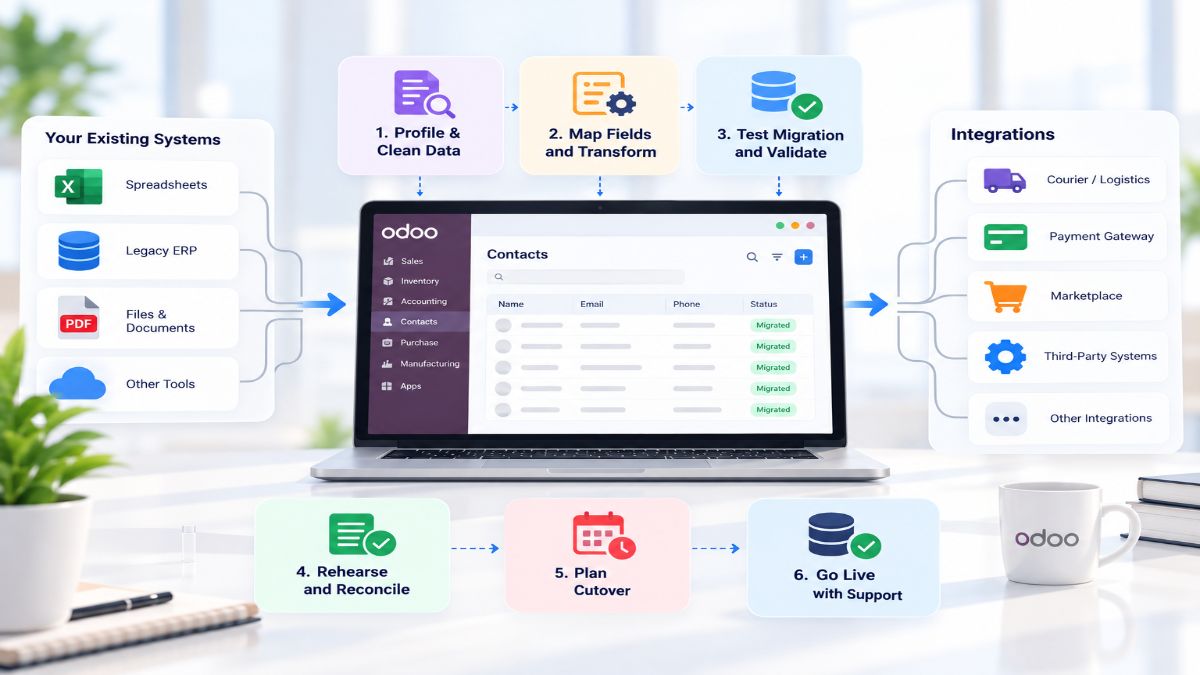
Say a distributor has 12,000 customer records. A fair few are duplicates: Smith & Co, SMITH CO, and so on. Somebody has to pick the survivor, and it has to be somebody from the customer’s side. That’s why profiling the data comes first, before any promises, and why field mapping waits until after.
One Odoo detail worth probing is the import tool’s External ID column. Fill it in and a second import updates the records the first one created, rather than making copies, and related records can point at each other across files. Leaving it out and re-running an import tends to double everything. A vendor who has done real migrations will have opinions about this.
Then came the rehearsals. Experienced teams run several mock migrations into a test database and check control totals against the source, things like customer counts, open invoices and stock value, because totals that don’t match mean the migration isn’t finished. We’d also bring over open items plus a few years of history. The rest gets archived, not dragged across.
Last comes the cutover, with a freeze window and a way back. Switching everything at once with no rehearsal and no fallback is how a failed cutover becomes an outage. Nobody wants to explain that on a Monday.
Integrations Are Project Two
Most businesses keep a few outside systems, say a payment provider and a courier. Maybe a marketplace feed too. Every one needs an owner at the vendor and a named person on your side. And who looks after each connection once the project is live? Vendors who go quiet at that question are telling you something.
Two API details matter here. Odoo’s docs say the external API is only available on Custom plans, not One App Free or Standard. The second: XML-RPC and JSON-RPC have been on the deprecated list since version 19.0, with JSON-2 as the replacement, though removal dates differ by service. Connectors built on the old endpoints will need redoing at some point.
Customizations Come With an Upgrade Bill
Odoo’s own upgrade guide for customized databases says custom modules get tested on a fresh database of the new version first. What breaks is fairly predictable: renamed fields and moved views, mostly. A vendor who writes a lot of custom code with no upgrade plan is leaving a bill for later. It tends to land on whoever signed the contract.
References
The best evidence is a past project about your size and just as messy. A reference who can describe the migration, what testing turned up and how long cutover took beats a case study with a logo. Vendors who’ve done this talk about the problems freely.
Contract Points
Who owns the migration scripts and mapping documents? Who pays if the first mock load fails? What counts as done for each integration? Dull questions. They settle most of the disputes.
Where to Begin
BiztechCS, an Odoo Ready Partner, tends to open these engagements with the data and the integration list, before any apps get configured. Slower to scope, fewer surprises. Anyone can show a clean demo. A vendor that can explain how a duplicate customer record gets resolved is the one more likely to finish.
 IQ Newswire
 Bruno Pisano